
A governed runtime for building agents, connecting operational systems, and turning every action into durable, explainable knowledge.


Public specification status · Repositories and skills · Contribution guide
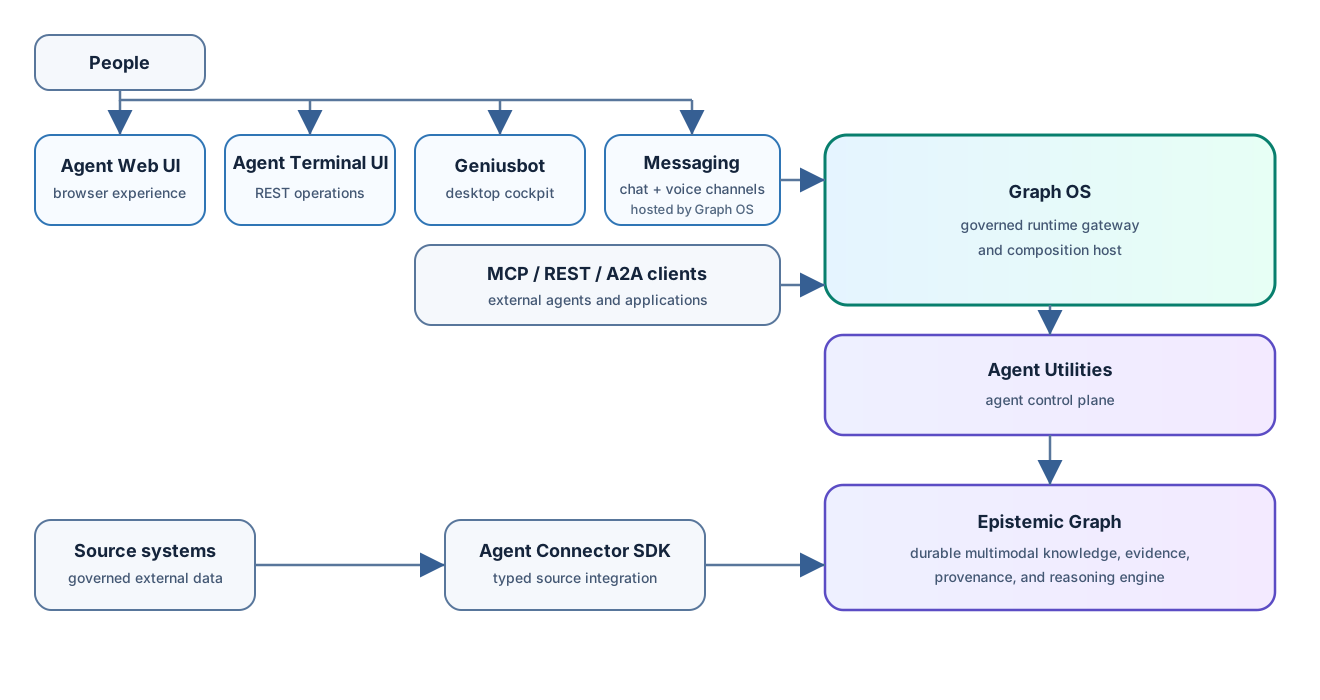
People use Agent Web UI, Agent Terminal UI, Geniusbot, or Graph OS-hosted messaging channels. MCP, REST, and A2A clients use the same governed Graph OS boundary. Graph OS composes the runtime and delegates agent work to the Agent Utilities control plane. Epistemic Graph commits durable knowledge, evidence, provenance, and reasoning results. Source systems connect through the governed Agent Connector SDK contract.
|
The public runtime gateway: MCP, REST, A2A, identity, policy, fleet composition, and WebUI hosting. |
The browser operator experience for conversations, approvals, tool activity, and graph-backed work. |
|
The agent control plane: agents, workflows, evaluation, skills, and governed execution. |
The reasoning and durable knowledge engine for graph, RDF, SQL, vectors, time, blobs, evidence, and provenance. |
|
The terminal operator experience for agent conversations, durable sessions, tool approvals, and live run monitoring. |
The desktop cockpit for specialist agents, embedded terminals, tool approvals, and graph-backed exploration. |
|
The governed source-integration boundary for connector identity, discovery, synchronization, replay, and write-back. |
|
Graph OS is the governed runtime entry point. With Python 3.12+ and uv installed, launch the zero-infrastructure local profile:
uvx --from graph-os setup-config generate --profile tiny
uvx --from graph-os graph-os --transport stdio
The generated profile starts with local, bounded defaults. Continue with the Graph OS quick start for provider configuration, Agent Web UI hosting, messaging, and authenticated network transports.
| If you want to… | Start here |
|---|---|
| Run the platform or connect an MCP/A2A client | Graph OS documentation |
| Use the browser experience | Agent Web UI documentation |
| Build agents, workflows, evaluations, or skills | Agent Utilities documentation |
| Query or operate the knowledge engine directly | Epistemic Graph documentation |
| Build or certify a source connector | Agent Connector SDK documentation |
Every repository documents its own contract and links back to this same runtime map. The boundaries are deliberate: Graph OS is the door, Agent Utilities controls agent behavior, Epistemic Graph owns durable knowledge and reasoning, Agent Web UI presents the browser surface, and Agent Connector SDK governs source integration.
Build and release evidence lives with the component that owns it. Use each repository's Actions page for current CI and its Pages Status or Capabilities section for shipped behavior. Public issues and pull requests are tracked in the owning repository so operational and design discussions retain their architectural context.
The organization specification report collects owner-native public specs across the core repositories and related public owners. Filter to SPECIFIED to find published work waiting to be built; delivery and acceptance are separate states. The contribution guide links the shared graph-os-development and spec skills.
Pick an open requirement in the specification status report, then read its owner repository's spec.md, requirements.md, plan.md, test-spec.md, tasks.md, and status.json. The owner repo defines the implementation; related repository specs describe consumers and interfaces. Bootstrap with graph-os-development, then use universal-skills: spec-generator, task-planner, sdd-implementer, spec-verifier, and sdd-full-lifecycle. The step-by-step guide covers local setup, reuse, tests, pull requests, and public evidence.
All five core projects are released under the MIT License.
